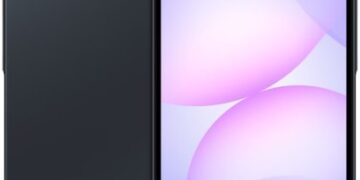






Samsung Galaxy A07 5G (SM-A076B/DS) 4GB/64GB — Complete Review and Buyer Guide
Samsung Galaxy A07 5G SM-A076B/DS (4GB/64GB) review: 6.7" 120Hz PLS display, Dimensity 6300, 6000mAh battery, 50MP rear camera, Android 16, 25W, Dual SIM.
The Samsung Galaxy A07 5G (SM-A076B/DS) is Samsung’s entry-level international dual‑SIM variant introduced in early 2026. This review consolidates the device’s hardware and software specifications, analyzes real‑world implications for performance, camera output, display and battery endurance, and provides practical recommendations for prospective buyers. Table of contents: Design, Size, and Durability; Display and Multimedia Performance; Performance, Memory, and Real‑World Benchmarks; Camera System and Photography Capabilities; Battery, Charging, and Endurance; Connectivity, Sensors, and Additional Features; Market Positioning, Pricing, and Purchase Recommendations. The aim is to deliver a single, comprehensive reference that answers what the A07 5G delivers for users who prioritize battery life, basic 5G connectivity, and affordability.
Design, Size, and Durability
The Galaxy A07 5G presents a straightforward, functional design geared toward practicality rather than premium aesthetics. Its footprint measures 167.4 mm in height, 77.4 mm in width and 8.2 mm in thickness (3.05 x 6.59 x 0.32 inches), with a mass of 199 g (7.02 ounces). These dimensions place the phone in the large‑screen category while remaining within a weight bracket that most users will find manageable for everyday carry and extended handset use.
Materials and construction are consistent with the budget tier. The device emphasizes cost efficiency without compromising on structural integrity; the casing and chassis give the impression of robust assembly, and ergonomics benefit from the moderate thickness and rounded edges that ease one‑handed grip despite the large 6.7‑inch display. Samsung has included a scratch‑resistant screen to reduce the risk of cosmetic damage in daily use.
Ingress protection on the A07 5G is described with ratings that signal basic defenses: protection from solids rated at level 5 (protected against dust with limited ingress) and protection from liquids rated at level 4 (protected against water sprayed from all directions, limited ingress). These ratings are modest — they do not match full IP67 or IP68 water immersion ratings — but they do mean the device tolerates light splashes and dusty conditions better than devices without any rated protection. Users should still avoid submersion or high‑pressure water exposure.
Physical controls and ports are in expected positions: a USB‑C reversible connector with USB 2.0 HS (480 Mbps) that supports USB PD, USB Host, USB OTG 1.3, and fast charging; a 3.5 mm headphone jack for wired audio; and physical buttons for power and volume. The SIM arrangement on the SM‑A076B/DS is dual Nano‑SIM (4FF) with dual standby operation, making the phone ready for travelers or users who need separate personal and work lines. Expandable storage via microSD (TransFlash, microSDHC, microSDXC) preserves flexibility despite the base 64 GB ROM.
Haptic touch feedback is present, elevating the tactile experience when interacting with One UI elements and system navigation. The phone includes a fingerprint sensor and face recognition for biometric access, with the fingerprint sensor categorized among the additional sensors alongside ambient light and proximity sensors. Stereo microphone input and a mono loudspeaker round out the communications hardware, while an FM radio with RDS is available for users who rely on terrestrial broadcasts.
Overall, the A07 5G’s design prioritizes practical everyday use: large screen, solid battery capacity, physical expandability, and basic ingress protection that fits the expectations of an affordable 2026 mid‑to‑low tier smartphone.
Display and Multimedia Performance
The A07 5G uses a 6.7‑inch Color PLS TFT LCD with a 720 x 1600 resolution. Pixel density is approximately 260 PPI, supporting 16.8 million display scales. The screen includes a single notch for the front camera and achieves 84.8% display area utilization, a respectable ratio that balances bezel presence and display real estate.
A standout spec in this budget class is the 120 Hz display refresh rate. A 120 Hz refresh provides noticeably smoother animations, scrolling, and system navigation compared with standard 60 Hz panels. It elevates perceived responsiveness for UI interactions and can improve the feel of motion in supported apps and games. Because the panel is PLS TFT LCD rather than OLED, expect differences in contrast ratio, absolute black levels and deep color rendering compared to Samsung’s AMOLED panels; blacks will look more grayish in dim environments and peak contrast will be lower. Color accuracy generally will be acceptable for casual use but not on par with premium OLED screens, which offer higher dynamic contrast and deeper saturation.
The 720p resolution on a 6.7‑inch display yields a trade‑off: battery savings and lighter GPU workload at the cost of less sharpness for text and high‑detail images. For typical social media browsing, streaming video at common resolutions (720p/1080p) and casual gaming, the display will be serviceable. Users who are sensitive to fine text rendering or who consume a lot of 4K/UHD content on the device may notice visible pixelation and a softer image relative to Full HD or higher displays.
Audio performance relies on a single loudspeaker, which provides reasonable loudness for calls, notifications and casual media. Expect limited stereo separation and a constrained low end. The inclusion of a 3.5 mm jack and FM radio with RDS remain practical benefits for users who prefer wired headphones or who need radio access without streaming. Bluetooth 5.3 ensures compatibility and improved power efficiency for wireless headphones and audio accessories, with benefits for latency and multi‑device pairing over older Bluetooth versions.
Scratch resistance and the presence of a 120 Hz panel in this price segment are notable. For media consumption and day‑to‑day tasks the display delivers smooth interaction and acceptable image quality; power users seeking the deepest blacks, highest pixel density, or HDR capabilities will find the panel limiting.
Performance, Memory, and Real‑World Benchmarks
Under the hood the Galaxy A07 5G utilizes a MediaTek Dimensity 6300 MT6835T chipset built on a 6 nm process, with an octa‑core CPU clocked at 2400 MHz and an ARM Mali‑G57MP2 GPU running at 962 MHz. The reference unit reviewed is configured with 4 GB of LPDDR4x RAM (2133 MHz databus) and 64 GB UFS 2.2 internal storage, yielding approximately 44,800 MiB of user‑accessible space after system files.
The Dimensity 6300 is a modern mid‑range 5G SoC focused on efficiency and balanced performance. In synthetic benchmark terms, it typically positions below flagship chipsets but is capable of handling daily tasks — multitasking, app launches, web browsing and media playback — with efficiency. The 6 nm node helps manage thermals and power draw, which benefits the phone’s substantial 6000 mAh battery.
Real‑world performance expectations:
- Everyday use: Smooth performance for messaging, social media, email, navigation, and streaming. The 4 GB RAM footprint is adequate for light multitasking but can be constrained if many apps are kept in memory simultaneously. One UI memory management may close background apps more aggressively than higher RAM configurations, so users should expect occasional app reloads when switching between multiple heavy tasks.
- Gaming: Casual and many mainstream titles will be playable at moderate settings. The Mali‑G57MP2 GPU and 720p resolution produce a favorable GPU workload balance, allowing playable frame rates in optimized games. Demanding 3D titles will require reduced graphics settings to maintain stable frame rates. Sustained gaming sessions may trigger thermal throttling depending on ambient temperature and workload.
- Storage and responsiveness: UFS 2.2 storage improves app load times and system responsiveness relative to eMMC-based solutions. 64 GB is modest in 2026; with a significant app library or local media collection, users will likely need microSD expansion to avoid running out of space.
- Multitasking and memory: LPDDR4x at 4 GB supports standard operations. Power users who frequently switch between memory‑heavy apps (large web pages, video editors, complex games, multiple camera apps) should consider variants with higher RAM where available.
The OS ships with Google Android 16 (Baklava) layered with Samsung’s One UI 8. This combination brings modern feature sets, updated privacy controls, and Samsung’s typical software polish. Out‑of‑the‑box performance benefits from software optimizations for the Dimensity platform, but the long‑term experience depends on the frequency and thoroughness of system updates from Samsung. For budget devices, update cadence often lags behind flagship lines; prospective buyers should verify the manufacturer’s update policy for security patches and major OS upgrades.
Storage expandability via microSD is a significant advantage in this memory‑conscious configuration. Users who plan to store many photos, offline maps, music files or video will appreciate the ability to offload bulky items to an external card, though app storage and certain system caches remain on internal UFS storage.
Taken as a whole, the A07 5G’s hardware and memory configuration are tuned for energy efficiency and affordability while remaining fully usable for mainstream smartphone tasks. The 120 Hz display and UFS 2.2 storage help maintain perceived snappiness despite the modest RAM ceiling.
Camera System and Photography Capabilities
The Galaxy A07 5G’s camera suite is pragmatic, emphasizing a versatile main sensor with essential computational features, supplemented by a functional auxiliary mono sensor and an 8 MP front camera for selfies and video calls.
Primary rear camera:
- Sensor: 50.1 MP BSI CMOS, 0.64 μm pixel size
- Aperture: f/1.8
- Focus: Phase detection autofocus (PD AF)
- Zoom: 1.0x optical equivalent, up to 10.0x digital zoom
- Video: 1920 x 1080 @ 30 fps
- Flash: Single LED
- Extras: Pixel unification (likely pixel binning), HDR photo, red‑eye reduction, slow motion, burst mode, touch focus, panorama, face detection, face tagging, smile detection, face retouch
The 50 MP primary sensor with pixel unification (commonly implemented as 4‑pixel binning) produces 12 MP equivalents in low light or high dynamic range scenarios, improving signal‑to‑noise and dynamic range. The f/1.8 aperture provides a reasonable light intake for a budget camera, aiding low‑light shots when combined with software processing. PD AF enables quick focus acquisition for typical subjects.
Given the camera’s hardware and software feature set, expected imaging performance:
- Daylight photography: Strong results for a budget device — good color, reasonable dynamic range, and detail sufficient for social sharing and casual prints. Pixel binning boosts low‑light performance and reduces noise at the expense of maximum resolution.
- Low light: The large effective sensor area with f/1.8 and pixel unification improves available light capture, but expect more noise and softer detail than premium devices with larger sensors or optical stabilization. Night mode (if present within One UI features) will likely rely on multi‑frame stacking to improve exposure.
- Zoom: No optical telephoto module means zoom relies on digital cropping. Up to about 2–3x may be usable with acceptable detail; higher digital zoom approaches will exhibit reduced clarity.
- Video: Limited to 1080p at 30 fps for both rear and front cameras. This is serviceable for social clips and everyday capture but lacks 4K capture and higher frame rate options for slow‑motion or high‑detail video work.
- Auxiliary mono sensor: The 1.9 MP mono sensor with 1.75 μm pixel size and f/2.4 aperture is likely designed to assist depth capture and low‑light luminance information rather than to serve as a standalone wide or macro camera. Its contribution is primarily computational, assisting bokeh and contrast adjustments.
- Front camera: 8.0 MP BSI CMOS, f/2.0, 1080p30 video, with software aids like HDR, burst, panorama and face retouch. Good for video calls and standard selfie use; image quality will be acceptable but not class‑leading.
Software extras such as face recognition, face retouch, and AI‑driven enhancements are in line with One UI features on Samsung’s budget devices. Users can expect automatic scene detection and HDR handling in many scenarios. For enthusiasts who prefer manual control, camera app settings often include exposure compensation, white balance presets, and scene modes; check the camera interface for a Pro mode if extended controls are desired.
Practical tips for photographic use:
- Use daytime and golden‑hour lighting for best results; avoid heavy digital zoom in low‑light.
- Enable HDR for scenes with high dynamic range (backlit subjects).
- When capturing video, stabilize the phone or use a tripod since there is no mention of optical image stabilization (OIS) for the primary sensor.
- Use the large battery and 25W charging to ensure the camera is ready over long outings.
In summary, the Galaxy A07 5G delivers a capable main camera for its class, focused on social media–ready stills and reliable selfie/video performance rather than advanced imaging or professional video capabilities.
Battery, Charging, and Endurance
Battery capacity is one of the A07 5G’s core strengths: a built‑in 6000 mAh Li‑ion battery. This is a generous cell for a 6.7‑inch device and greatly influences the phone’s daily usability and long‑run reliability. Combined with the power‑efficient Dimensity 6300 6 nm chipset and a 720p display, users should expect multi‑day battery life under conservative use and at least a full day of heavy use in most scenarios.
Charge management:
- Max charging power listed at 25.0 W with USB PD support through the USB‑C reversible port. This level of fast charging reduces refill time compared to older slow chargers, though it is slower than flagship high‑wattage regimes. Nevertheless, 25W on a 6000 mAh battery still requires a longer charging window than smaller batteries; expect around 60–80 minutes for a substantial charge and approaching two hours for a near‑full top‑up depending on charging curves and thermal management.
- USB features include USB charging, USB fast charging, USB Host and OTG, and USB PD. These options add convenience for fast top‑ups and accessory compatibility.
Real‑world autonomy examples (projected based on capacity and platform efficiency):
- Light use (calls, messaging, email, occasional browsing): 2–3 days.
- Moderate use (social apps, some streaming, navigation, photos): 1.5–2 days.
- Heavy use (gaming sessions, long video playback, frequent camera use, GPS navigation): a full day or slightly beyond depending on screen refresh rate usage (120 Hz increases power draw).
The phone’s 120 Hz refresh setting will raise system fluidity but reduces battery longevity when enabled. One UI typically provides adaptive display settings and battery saver profiles; enabling a 60 Hz fallback or adaptive refresh (if available) will extend run time. Users can also manage background refresh and connectivity (Wi‑Fi vs cellular) to eke out longer usage.
Thermal behavior under charging and sustained load benefits from the efficient chipset, but extended gaming or continuous video recording will generate heat which can slightly degrade charging speed as thermal throttling engages. For users prioritizing battery endurance above all, the A07 5G’s 6000 mAh cell is a compelling proposition in its price segment.
Connectivity, Sensors, and Additional Features
Connectivity is a key part of the A07 5G’s appeal. The device supports a broad set of cellular bands including numerous LTE bands and a wide selection of 5G NR bands (N1, N3, N5, N7, N8, N26, N28, N77, N78 and others), along with TD‑LTE and TD‑NR frequencies. This range positions the SM‑A076B/DS as an internationally capable handset for Asia and Oceania markets, with specific country availability listed for the Philippines and broader distribution across Asia, Southeast Asia and Oceania.
Dual SIM dual standby facilitates business/personal separation or dual‑operator setups, while the extensive supported data links (GPRS, EDGE, UMTS, HSPA, LTE with various throughput tiers, and NR with multiple data rates) ensure the device aligns with modern network capabilities including VoLTE, HD Voice and Wi‑Fi Calling. Such support is valuable where carriers require specific bands or VoLTE certification for optimal voice quality.
Wi‑Fi supports 802.11a/b/g/n/ac, enabling connection to 5 GHz networks and higher throughput local networks. Wireless services include Wi‑Fi Direct, Wi‑Fi Tethering and Wi‑Fi Calling. Bluetooth 5.3 offers improved power efficiency, range and audio performance over older Bluetooth generations.
Navigation capabilities are comprehensive: simultaneous GPS, A‑GPS, GLONASS (L1OF), Galileo (E1), BeiDou (B1I), QZSS and QuickGPS. These services combine for accurate location lock and robust satellite coverage across regions. Complementary positioning features such as geotagging and quick satellite acquisition help mapping and navigation tasks.
Sensors include compass, accelerometer, gyroscope, fingerprint sensor, ambient light and proximity sensors. The presence of gyroscope and compass supports augmented reality applications and precise heading information for navigation apps. The included fingerprint sensor and face recognition provide secure and convenient biometric authentication.
Audio interfaces combine stereo microphone capture and a mono loudspeaker with a 3.5 mm audio jack. The FM radio with RDS remains an advantage for users in areas where broadcast radio is commonly used or where data connections are limited. SAR values are specified at 1.230 W/kg (head) and 1.290 W/kg (body), consistent with regulatory disclosures.
Finally, the software extras — voice command, navigation software, voice recognition, face recognition — are integrated into One UI 8 on top of Android 16. These features add convenience in hands‑free contexts and for navigation tasks while maintaining the expected One UI user experience.
Market Positioning, Pricing, and Purchase Recommendations
The Galaxy A07 5G (SM‑A076B/DS) targets budget‑conscious consumers who want dependable battery life, large screen usability and basic 5G connectivity without paying flagship premiums. The combination of a 6000 mAh battery, 6.7‑inch 120 Hz display and capable Dimensity 6300 chipset is tailored to users who value longevity and everyday responsiveness over leading‑edge camera systems or premium materials.
Key value drivers:
- Battery life: The large 6000 mAh battery is a primary selling point and differentiator in the price class.
- Connectivity: Broad cellular band support and dual SIM capability make the phone versatile for international travel and multi‑SIM use.
- Smooth UI: A 120 Hz display and UFS 2.2 storage create a responsive everyday experience despite the 4 GB RAM configuration.
- Expandability: microSD support offsets the modest internal 64 GB storage for media‑heavy users.
Considerations before purchase:
- Display resolution: 720p on a 6.7‑inch panel is acceptable for many users but will not match the sharpness and contrast of Full HD OLED panels. Buyers who prioritize display fidelity for text clarity or video quality should compare to alternatives with higher resolution or OLED panels.
- Camera limitations: The 50 MP primary sensor is competent for casual photography, but the lack of optical stabilization and limited video capabilities (1080p30 only) means the phone is not optimized for advanced photo or videography tasks.
- RAM ceiling: 4 GB RAM suits mainstream use; however, power users who multitask heavily should look for variants with higher RAM if available.
- Software updates: Check the regional update policy to understand how many OS upgrades and security patches Samsung will provide for the A‑series model in your market.
Who will find this phone most attractive:
- Travelers and dual‑SIM users who need broad band compatibility and long battery life.
- Users who consume media casually and prefer smooth navigation over peak display fidelity.
- Buyers on a constrained budget who require dependable daily performance and expandable storage.
- Users who value a physical headphone jack, FM radio, and robust battery longevity.
Who should consider alternatives:
- Photographers and videographers seeking OIS, 4K capture or multi‑camera versatility.
- Users who prioritize a high‑contrast OLED screen for media consumption or color‑accurate work.
- Power users requiring extensive multitasking with many heavy apps open simultaneously.
Purchase recommendations:
- If long battery life and reliable everyday performance are top priorities and you are comfortable with a 720p PLS LCD, the Galaxy A07 5G is a strong value proposition.
- For heavy gamers or photography enthusiasts, evaluate mid‑range alternatives that offer higher RAM, OLED displays, faster charging, or improved imaging subsystems.
- Verify local firmware/region compatibility for the wide band support; confirm VoLTE and Wi‑Fi Calling compatibility with your carrier before purchase if these services are critical.
Final purchase checklist:
- Confirm the variant (SM‑A076B/DS) matches the dual‑SIM and band requirements for your region.
- Inspect included charger specifications to ensure it supports 25W USB PD or plan to purchase a compatible charger.
- Consider a microSD card if you plan to store significant media locally.
- Use protective accessories to augment the phone’s ingress protection and preserve the scratch‑resistant screen.
The Galaxy A07 5G represents a pragmatic balance between modern features and affordability, prioritizing endurance and core functionality in the 2026 smartphone landscape.
The Galaxy A07 5G is a pragmatic, battery‑centric device that delivers reliable 5G connectivity, a smooth 120 Hz user interface and a large 6000 mAh battery in a cost‑conscious package. For users whose priorities center on long runtime, dual‑SIM flexibility and everyday performance, the SM‑A076B/DS with 4 GB RAM and 64 GB storage is a coherent offering. Where the model compromises — display resolution, advanced imaging features and top‑end performance — are predictable for the segment; buyers who accept those tradeoffs will find a capable and practical smartphone that performs well for communication, media consumption and protracted daily use.