





Google Pixel Watch 4 (41mm) — Full Technical Review and Practical Guide
Meta description: Google Pixel Watch 4 (41mm) review: detailed specs, Gemini AI on-wrist, Snapdragon W5 Gen 2, 1.3" AM‑OLED, 325 mAh battery, IP68, LTE eSIM — hands-on analysis.
The Pixel Watch 4 41mm with global LTE (GWSQ2) positions Google’s latest wrist platform around conversational AI, standalone cellular, and a compact AMOLED screen. This article breaks down every important specification and explains how each translates to daily use. Table of contents: Design, Size and Wearability of the Pixel Watch 4 41mm; Display, Touch and Visibility in Daylight; Processor, Memory and Daily Performance; Battery, Charging and Real-world Endurance; Health Sensors, Fitness Tracking and Safety Features; Cellular, Connectivity and Compatibility; Software Experience: Gemini on your wrist and Wear OS 6. Each section includes targeted observations and practical implications to help buyers and technical readers make an informed decision.
Design, Size and Wearability of the Pixel Watch 4 41mm
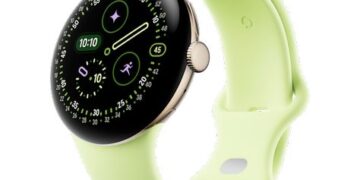
The Pixel Watch 4 in the 41mm case measures 41 mm in width and height, with a depth of 12.3 mm. In imperial units, dimensions are listed as 1.61 x 1.61 x 0.48 inches. The device weighs 31 grams (approximately 1.09 ounces), placing it in the light-to-moderate weight class for modern smartwatches. The compact footprint and modest mass favor users who prefer a smaller, less obtrusive device on their wrist or those with narrower wrists. The 41 mm designation refers to the case diameter, which is a common consumer size that balances display area and ergonomics.
Build details provided in the datasheet emphasize fit and finish through practical attributes such as haptic touch feedback and a capacitive multi-touch screen. While the record does not specify case material, the mechanical thickness (12.3 mm) suggests that Google prioritized internal component layout, cellular radios, and battery capacity within a slim but functional profile. The result is a watch that sits close to the wrist while accommodating LTE hardware and a 1-cell Li-ion battery.
Strap compatibility and quick interchangeability typically matter for daily wear and personalization. The 41mm form factor remains widely compatible with third‑party bands designed for smaller Pixel/Android smartwatches, but buyers should confirm lug widths and quick-release mechanisms when shopping for aftermarket straps. The light mass reduces band-induced torque, which helps comfort during long wear and while exercising.
Ingress protection is an essential design factor for wearables intended for everyday and active use. The Pixel Watch 4 is rated to protection class 6 for solids (totally dust protected) and class 8 for liquids (protected against immersion beyond 1 meter). Together, those values correspond to practical IP68-level protection. An immersion depth limit is explicitly listed as 5000 cm (50 meters), which provides reassurance for common water exposure scenarios — showering, rain, swimming in shallow pools — but users should follow manufacturer guidance for prolonged submersion and specific activity modes.
The watch ships in a 41 mm diameter that suits many wrists and offers a balance between screen size and unobtrusiveness. Weight, immersion protection, and haptic feedback combine to create a wearable designed for continuous carry: sleep tracking, all-day health monitoring, and hands-free voice interactions. The mono speaker and mono microphone integrated into the case are sized and tuned for conversational use and system prompts, rather than high-fidelity media playback.
Display, Touch and Visibility in Daylight
Pixel Watch 4 uses a 1.3-inch AM‑OLED panel with a 408 x 408 resolution, delivering a pixel density of 458 PPI. Those figures indicate a sharp display with smooth text and crisp watch faces at typical viewing distances for a smartwatch. The display supports approximately 16.8 million colors and refreshes at 60 Hz. For the majority of smartwatch tasks — notifications, watch faces, maps, fitness metrics — a 60 Hz refresh rate is a standard and power-efficient choice that avoids the complexity and battery cost of high-refresh modes.
Physically, the screen is covered with Gorilla Glass 5, providing scratch resistance and better drop resilience than earlier glass types. Gorilla Glass 5 is a reasonable compromise for a wrist-worn device that encounters repeated contact with clothing and surfaces. The datasheet lists a horizontal full bezel width of 18.37 mm and display area utilization at 30.5 percent. That last percentage suggests a design with an intentional bezel and a circular aesthetic that places the interface elements within a clear, robust frame. The bezel size affects how watch faces are designed and how usable edge gestures feel; some users will prefer larger bezels for durability and button/gesture clarity, while others favor high screen-to-body ratios for maximal information density.
Touch input is handled by a capacitive multi-touch touchscreen. Multi-touch enables native gestures common to Wear OS apps, such as pinch-to-zoom in maps or multi-finger swipes for quick actions. Haptic touch feedback augments the touchscreen with tactile confirmation, improving perceived responsiveness when interacting with small UI elements.
Brightness and outdoor visibility are crucial for daily use. While specific nits values are not supplied, AM‑OLED technology combined with the high pixel density and Gorilla Glass 5 typically yields excellent contrast and legibility. Ambient brightness sensors (listed among additional sensors) allow automatic brightness control to reduce glare and conserve battery. Users who frequently access glanceable information outdoors — navigation directions, call prompts, or workout stats — will find the combination of AMOLED and automatic brightness effective for most conditions.
The display’s 408 x 408 resolution maps cleanly to circular UI layouts, assuring crisp typography and adequate room for map and notification content. For developers and designers, the 1.3-inch, 458 PPI reference provides exact constraints when creating watch faces and companion app interfaces to avoid clipped or cramped text.
Processor, Memory and Daily Performance
Under the hood, the Pixel Watch 4 runs on the Qualcomm Snapdragon W5 Gen 2 4G SWS5150. This chipset, fabricated on a 4 nm process, includes a quad‑core CPU clocked at 1,700 MHz and a Qualcomm Adreno 702 GPU with a listed GPU clock of 1,000 MHz. This silicon combination is explicitly targeted at wearable workloads: responsive UI rendering, sensor fusion, always-on features, and on-device AI inference where applicable. The W5 Gen 2 platform offers improved power efficiency compared with earlier wearable chipsets, which benefits continuous sensor sampling and tasks that require dual low-power and main compute domains.
RAM capacity is 2 GiB using LPDDR4x SDRAM at a 2,133 MHz databus clock. On a wearable, 2 GB of RAM is sufficient for fluid Wear OS 6 multitasking and background processes such as health monitoring services, notifications synchronization, and background network activity. Non-volatile storage uses eMMC 5.1 with 32 GB ROM. The 32 GB local storage explicitly supports offline maps, music caching, apps, and firmware resources without reliance on a paired phone.
Daily performance expectations for the Pixel Watch 4 should be consistent: fast app launches, smooth watch face animations, reliable sensor readouts, and competent map redrawing. The Adreno 702 GPU and the 60 Hz display improve UI responsiveness and animations. Complex tasks such as on-device AI queries from Gemini or processing continuous health telemetry will leverage the chipset’s efficiency and on-device accelerators, but heavy-duty computational tasks remain constrained by the watch’s thermal and battery envelopes.
The operating environment is Google Wear OS 6 running on a Linux-based platform. Wear OS 6 includes standard Wear OS app frameworks, voice command integration, and navigation components. Software extras explicitly include voice command and navigation software. Those features integrate with hardware such as the microphone, speaker, haptic motor, and A‑GPS/dual-frequency GPS to deliver a hands-free experience for turn-by-turn directions and voice-driven assistance.
Memory and storage numbers provide practical headroom for users who want to keep podcasts, music, and watch faces on-device alongside apps. eMMC 5.1 isn’t as fast as UFS found in smartphones, but for wearable-class workloads and smaller file sets, it is an appropriate balance of performance and power efficiency. The combination of a modern wearable SoC, 2 GB RAM, and 32 GB ROM positions the Pixel Watch 4 for a smooth multi-day wearable experience with fast UI responsiveness.
Battery, Charging and Real-world Endurance
Battery capacity for the Pixel Watch 4 is listed at 325 mAh and described as a single built-in Li-ion cell. The datasheet provides an estimated battery life of 30.0 hours. Real-world endurance on smartwatches varies widely depending on usage patterns: always-on display settings, continuous heart-rate monitoring, GPS use during workouts, LTE connectivity, and on-device AI interactions all influence drain rates.
The 325 mAh capacity aligns with the expectation for a 41 mm watch that seeks to remain compact. With efficient chipset design (Snapdragon W5 Gen 2) and AMOLED display characteristics, typical mixed usage — periodic notifications, background health monitoring, short GPS workouts, and occasional LTE use — is consistent with the stated 30‑hour estimate. Heavy LTE use, long navigation sessions, or frequent on-demand voice interactions with Gemini will shorten that window. Conversely, conservative settings (disabling always-on display, restricting LTE, using battery saver modes) can extend runtime beyond the estimate.
Pixel Watch 4 supports USB charging and USB fast charging services, although the watch itself lacks a built-in USB connector. The practical implication is a proprietary or magnetic charging puck that connects to a USB power source. Fast charge capability reduces downtime and makes short top-ups before heading out practical. For many users, a daily overnight charge or a short top-up during midday will maintain reliable operation.
Charging strategy matters with a 30-hour baseline. Users who require multi-day autonomy — for example, multi-day hiking trips or extended time away from power — should evaluate backup charging options or settings that reduce power draw. Wear OS typically includes power saving modes that limit background activity and sensor polling to extend battery life for critical periods. The watch’s on-board battery hardware and charging behavior should be factored into any purchase decision where full-day continuous monitoring and frequent LTE independence are priorities.
Manufacturers sometimes publish charging time targets; since precise charge time is not provided here, users can expect fast-charging to recover several hours of runtime in 15–30 minutes depending on the charger and puck. For a 325 mAh cell, modern fast charging protocols can rapidly top the battery to usable levels, but a full charge from empty may still take longer.
Health Sensors, Fitness Tracking and Safety Features
Pixel Watch 4 incorporates a comprehensive sensor array aimed at health and fitness monitoring. The watch includes a heart-rate sensor, SpO2 sensor, a body composition analyzer (BIA), a step counter, altimeter, barometer, thermometer, ambient light sensor, a 3D accelerometer, gyroscope, and a compass. GNSS features include A-GPS, dual-frequency GPS, QuickGPS, QZSS, GLONASS L1OF, Galileo E1, and BeiDou B1I. That satellite coverage supports accurate positioning and faster fixes across regions where those constellations are available.
The heart-rate sensor and SpO2 sensor provide continuous heart-rate tracking, resting heart-rate analysis, and oxygen saturation readings. These signals enable sleep staging, exercise intensity metrics, and health trend tracking. The inclusion of BIA (bioelectrical impedance analysis) is notable for a wrist device because BIA traditionally requires specific electrode configurations. On the Pixel Watch 4, BIA likely contributes to periodic body composition estimates when paired with software algorithms; users should follow manufacturer guidelines for measurement posture and frequency for reliable readings.
Altimeter and barometer readings support elevation-aware activities and can detect relative changes in altitude for stair climbing or hiking. The thermometer can assist in sleep and body temperature trend analysis where software supports such features. The accelerometer and gyroscope enable step counting, activity recognition (walking, running, cycling), and fall detection algorithms if implemented. A built-in compass helps navigation and orients map displays without needing to rely solely on GPS heading.
Satellite SOS is listed as a supported satellite service. When implemented in the device and supported regionally, Satellite SOS can provide emergency messaging where terrestrial networks are unavailable. The presence of dual-frequency GPS improves positioning accuracy in challenging environments such as urban canyons and dense foliage by mitigating multipath errors.
For fitness users, the watch’s sensors combined with built-in navigation and fitness apps provide route tracking, pace and cadence measurement, elevation data, and workout summaries. Data reliability depends on sensor fusion algorithms and software calibration; the hardware supports advanced tracking but software performance determines final accuracy and value.
Health and safety features are also supported by voice command and a mono speaker/microphone, enabling hands-free emergency calls or voice-initiated assistance through on-device AI. Voice transmission and voice speaker capabilities in the datasheet indicate that the watch supports standalone voice calls using its eSIM and LTE connectivity — an important feature for users who want to leave their phone behind during workouts.
Cellular, Connectivity and Compatibility
The Pixel Watch 4 is explicitly a Global LTE model with an eSIM slot and broad band support across UMTS and LTE frequencies. The listed bands cover UMTS2100 (B1), UMTS1900 (B2), UMTS1700/2100 (B4), UMTS850 (B5), UMTS900 (B8), and a comprehensive range of LTE bands including B1, B2, B3, B4, B5, B7, B8, B12, B13, B17, B18, B19, B20, B25, B26, B28, B66, B71, among others. Supported cellular data links include UMTS, HSUPA (5.8), HSDPA, HSPA+ 21.1, and LTE data profiles with peak down/up link categories listed up to LTE 150/50 in the datasheet. These capabilities enable the watch to function as a standalone communicator for voice, messaging, streaming, navigation and emergency services when out of range of a paired phone.
eSIM support is essential for seamless operator provisioning and often allows simultaneous association with a primary smartphone number or a distinct wearable plan depending on carrier policies. The datasheet lists a large number of mobile operators across regions, including major carriers in the USA (AT&T, T‑Mobile, Verizon), Europe (Vodafone, Orange, Deutsche Telekom), and Asia-Pacific (SoftBank, NTT DoCoMo, KDDI). This compatibility indicates the watch is positioned for broad international use but users should confirm carrier support and eSIM provisioning specifics before purchase.
Bluetooth 6.0 enables local pairing and accessory connections such as earbuds and nearby phones with reduced power consumption and improved throughput. Wireless LAN support spans legacy 802.11a/b/g/n/ac plus 802.11ax (Wi‑Fi 6), giving the watch modern Wi‑Fi connectivity for faster syncs, software updates, and cloud-based features when available. NFC A and B support allow tap payments and contactless interactions where payment providers and local services are configured.
Notably, the device lacks a physical USB connector and expansion interfaces; charging and data transfers are handled through the magnetic charging accessory and over-the-air syncs. For users who rely on tethered file transfers or wired charging, this is an expected trade-off in modern wearables that prioritize waterproofing and compactness.
Complex network conditions, operator feature sets, and local roaming rules affect real-world cellular performance. The presence of global bands and support for LTE category links provides flexibility, but buyers should verify whether their preferred carriers offer wearable plans and whether the specific Pixel Watch 4 SKU is validated for their network’s bands and firmware.
Software Experience: Gemini on your wrist and Wear OS 6
The Pixel Watch 4 runs Google Wear OS 6 on a Linux platform and integrates Google’s Gemini AI assistant directly on-device. Wear OS 6 brings familiar Google services — notifications, maps, messaging, and third‑party apps — to the wrist with a focus on streamlined interactions and battery-aware background behavior. Voice command and navigation software are called out as software extras, and the inclusion of on-device Gemini suggests enhanced conversational and contextual assistance without constant reliance on a paired phone.
Gemini as an on-watch assistant enables natural-language queries, task completion, proactive suggestions, and personalized help. On-watch AI can improve quick interactions such as summarizing messages, composing short replies, or initiating navigation, while minimizing the need to reach for a phone. The presence of local compute (W5 Gen 2) and 32 GB of storage supports on-device models and caching of AI resources, but privacy and latency behavior will be shaped by how Google balances on-device inference and cloud-based processing.
Wear OS 6’s app ecosystem supports third-party fitness and productivity apps. The watch’s 2 GB RAM and modern SoC should make the app experience responsive, but final performance depends on app optimization for Wear OS 6 and the circular display. Gemma — the watch’s voice and haptic feedback — helps interaction when glanceability is limited or when hands are otherwise occupied.
Software updates are a central component of long-term device value. Wear OS platforms typically receive periodic feature and security updates, and Pixel devices often receive prioritized updates. While update cadence is a software policy matter, the combination of Google hardware and Wear OS 6 suggests a stable and evolving software environment.
UX considerations include the mono microphone and speaker, which are adequate for voice interactions and short calls. Haptic feedback provides discrete confirmation for privacy-aware notification handling. On-device navigation plus dual-frequency GPS and compass support effective route guidance without a connected phone. However, the absence of stereo audio and a dedicated audio output limits on-watch multimedia playback; users will rely on Bluetooth audio accessories for music.
For privacy-conscious users, local AI inference and on-device storage options provide control over what data is uploaded to cloud services. The watch’s sensors and health data are sensitive by nature, so the software layers that handle permissions, encryption, and sync behavior dictate real-world privacy assurances. Wear OS includes controls for app permissions and connectivity, and enterprise or consumer policies often determine what data is shared across Google accounts and third-party services.
Final unlabeled paragraph:
The Pixel Watch 4 41mm Global LTE combines a compact, wearable-friendly design with a modern Snapdragon W5 Gen 2 platform, comprehensive sensor arrays, and full standalone connectivity through eSIM and broad LTE band support. Its 1.3-inch AM‑OLED at 408 x 408 pixels delivers a sharp, contrast-rich interface protected by Gorilla Glass 5, and the sensor suite — heart rate, SpO2, BIA, dual-frequency GNSS, altimeter and barometer — targets both health tracking and outdoor activity. With 2 GB of LPDDR4x RAM and 32 GB of eMMC storage, Wear OS 6 runs smoothly while on-device Gemini adds conversational assistance and voice-driven workflows from the wrist. A 325 mAh battery with an estimated 30-hour life and fast charging balances size and runtime, but real endurance will vary with LTE, GPS and AI usage. IP68-level ingress protection supports everyday water exposure and active lifestyles, and compatibility with a wide set of carriers and Wi‑Fi 6 ensures connectivity in most markets. For users seeking a compact Pixel-branded watch with true standalone cellular, advanced tracking sensors, and direct access to Google’s assistant capabilities on-wrist, this model offers a balanced package; prospective buyers should verify carrier eSIM support and consider individual battery and feature priorities before purchase.