





Pixel Watch 4 (45mm WiFi) review: design, display, performance, battery, sensors and real-world verdict
A compact flagship for wearables, the Pixel Watch 4 45mm WiFi (codename Kenari) blends a high-brightness domed display, a modern Snapdragon wearable SoC, and a broad sensor suite into a lightweight package aimed at health-aware users who prioritize screen quality and reliable positioning. This review unpacks the Pixel Watch 4’s physical design and materials, display technology and outdoor visibility, platform performance and memory architecture, battery capacity and charging behavior, connectivity and sensor capabilities, ingress protection and build durability, and practical acquisition considerations such as pricing and global availability. Table of contents: Design and build; Display and visual performance; Performance and software ecosystem; Battery, charging and real-world endurance; Connectivity, sensors and navigation accuracy; Durability, ingress protection and physical resilience; Value, availability and who should buy.
This article takes the device’s published specifications as its foundation and evaluates practical implications for everyday use. Throughout, measurements and spec items are referenced directly from the device data sheet and explained in context to help prospective buyers understand trade-offs and likely performance in common scenarios such as exercise tracking, outdoor use, commuting, and app responsiveness. The review also highlights potential limitations — for example, the WiFi-only model’s lack of cellular bands, the modest RAM footprint relative to modern smartphone standards, and the device’s mono audio configuration — and offers actionable guidance for buyers deciding between this watch and alternative wearable strategies.
Design and Build: Domed Gorilla Glass and Compact Dimensions
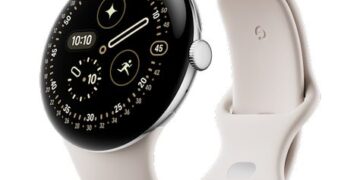
The Pixel Watch 4’s physical presentation emphasizes a clean, minimalist silhouette matched with a domed front that extends the visible area to the edges. The datasheet lists the device as 45 x 45 x 12.3 mm (1.77 x 1.77 x 0.48 inches) and weighing 36.7 grams (1.29 ounces). At that footprint the 45 mm case positions the watch toward the larger end of mainstream smartwatch sizes, while the sub-37 gram mass keeps it comfortable for all-day wear and for overnight health-tracking sessions such as sleep analysis.
Material choices and exterior finish determine both perceived quality and long-term durability. The Pixel Watch 4 introduces an edge-to-edge Corning Gorilla Glass surface on a domed glass panel. The datasheet specifies Gorilla Glass 5 for scratch resistance. The domed geometry increases the active viewing area compared with a flat face, producing an expansive look and reducing the visual bezel when a watch face or notification is displayed. The device also includes haptic touch feedback as a general extra, which is typical for a polished user experience where vibration cues complement visual and audible notifications.
Dimensionally, the 45 mm diameter and 12.3 mm thickness place the watch within a common comfort zone for users with medium to larger wrists. The weight is deliberately low, which is an advantage for continuous biometric monitoring and long workouts. The watch’s overall mass and dimensions make it unlikely to feel cumbersome during high-intensity activities or while sleeping, but its thickness—driven in part by internal battery capacity and sensor stack—means users with smaller wrists should confirm how the watch sits beneath clothing and whether the domed glass interacts with cuffs.
Physical ergonomics extend beyond raw numbers: button placement, band attachment, and curvature of the case affect everyday handling. While this review cannot show the physical band or clasp particulars, the 45 mm model’s scale typically uses standard quick-release strap compatibility or proprietary lugs. Buyers that prioritize interchangeability should verify strap widths and attachment systems before purchase. The Pixel Watch 4’s balance of substantial presence, lightweight feel, and domed protective glass aims to offer a premium tactile and visual experience without significant weight penalties.
Display and Visual Performance: 1.4-inch AM-OLED at 3000 nits
The display is the Pixel Watch 4’s most prominent hardware headline. The watch uses a 1.4-inch (36 mm) AM-OLED panel with a square-ish 456 x 456 resolution that yields a pixel density of approximately 455 PPI. These numbers indicate crisp text rendering and smooth watch-face graphics well-suited to small-screen reading. Color depth of 16.8 million shades supports vivid watch faces and accurate visualizations for maps and health metrics.
Two display attributes deserve special attention: the domed Gorilla Glass surface and an exceptional peak brightness figure listed at 3000 nits. The domed Gorilla Glass design increases the perceived screen size by reducing foreground bezel interruption; it also changes optical reflections and lensing behavior at extreme viewing angles. The Gorilla Glass 5 scratch-resistance rating provides a baseline for wear resistance, but the domed surface can make the watch more susceptible to impact on corners and edges. Users who frequently encounter abrasive surfaces or rugged outdoor activity may benefit from additional protective measures such as a thin screen protector specifically cut for a domed surface.
Peak brightness of 3000 nits is a standout specification. For everyday indoor use the panel will operate at far lower luminance, but the high peak brightness yields two concrete advantages: first, superior outdoor readability in direct sunlight, and second, greater headroom for HDR-type watch faces and visual highlights where brief peaks of luminance improve contrast. Practical effects include easier glanceability during daylight runs, bike rides, or commute waits under bright sky conditions. That said, sustained operation at very high brightness increases power consumption and can affect battery life, so adaptive brightness management and automatic scaling during ambient-light detection will be important to balance visibility and endurance.
The display refresh rate is 60 Hz, which is standard for many smartwatches. Combined with the Snapdragon W5 Gen 2 and Adreno 702 GPU, animations, transitions, and scrolling should appear smooth. The datasheet reports a horizontal full bezel width of 19.54 mm and a display area utilization figure of 32.0 percent; while this utilization number appears conservative, the effective edge-to-edge domed design will make the active content feel visually larger. The 456 x 456 resolution on a 1.4-inch diagonal delivers ample pixel density for crisp maps, notification text, and fine-grained watch face complications.
Careful buyers should note that display durability depends on use patterns. The Gorilla Glass 5 rating provides abrasion resistance but is not scratch-proof; avoid keys, tools, or coarse rock surfaces in direct contact with the face. Night mode and ambient display settings impact both visibility and battery life; users who value always-on readability should test the watch in their typical lighting conditions to find a brightness and refresh strategy that meets both visibility and battery-life goals.
Performance and Software Ecosystem: Snapdragon W5 Gen 2, Wear OS 6, and Memory Architecture
At the heart of the Pixel Watch 4 is Qualcomm’s Snapdragon W5 Gen 2 SW5150, a quad-core 64-bit chipset manufactured on a 4 nm process and paired with an Adreno 702 GPU running at an indicated 1000 MHz GPU clock. The CPU clock is specified at 1700 MHz. This SoC is purpose-built for advanced wearables: it balances compute headroom for interactive watch faces and third-party apps with power efficiency targets necessary for multi-day sensor operation.
Memory and storage choices influence real-world responsiveness and the scope of apps that can be installed. The Pixel Watch 4 ships with 2 GiB of LPDDR4x RAM at a 2133 MHz databus clock and 32 GB of eMMC 5.1 non-volatile storage. The 2 GiB RAM capacity is a realistic, conservative choice for a smartwatch platform: it is ample for responsive core UI performance, background sensor processing, and a reasonable set of installed apps, but heavy multitasking or memory-intensive third-party applications can stress available RAM. Developers targeting Wear OS 6 should optimize memory usage accordingly; from a user perspective, occasional reloads of app interfaces may occur if multiple apps are active concurrently.
Storage at 32 GB is generous for a wearable. It allows on-device music and podcast caches, offline maps, and a variety of installed apps without immediate space pressure. The eMMC 5.1 interface is reliable for mass storage in embedded devices, guaranteeing predictable read/write performance for application data and cached media; however, it is not as fast as the latest UFS interfaces, so very large application installs or frequent large-file transfers may show moderate throughput limits.
The Pixel Watch 4 runs Google’s Wear OS 6 on a Linux platform. Wear OS 6 continues the platform’s focus on integrated Google services, voice interactions, navigation features, and a growing ecosystem of third-party fitness and utility apps. Software extras listed on the datasheet include voice command and navigation software, both of which benefit from the device’s microphone and the integrated GPS stack. For users who rely on voice queries, the mono microphone and voice-command integration provide practical hands-free control; the mono loudspeaker allows short voice responses, notifications, and call audio when paired with a phone.
From a graphics standpoint, the Adreno 702 GPU and 60 Hz panel should render watch faces and animation fluidly. The combination of Snapdragon W5 Gen 2 and Wear OS 6 is well-suited for modern wearable interactions: smooth transitions, reliable sensor fusion for activity detection, and support for progressively rich watch-face complications. Power management remains a primary concern for smartwatch platforms; Wear OS 6’s scheduling and Qualcomm’s SoC power states will determine how long the Pixel Watch 4 can perform sensor-heavy tasks such as continuous heart-rate tracking or real-time navigation before requiring a recharge.
Battery, Charging and Real-World Endurance: 455 mAh and 40-Hour Estimate
Battery capacity is a central element of usability for any smartwatch. The Pixel Watch 4 is equipped with a built-in, single-cell Li-ion battery with a nominal capacity of 455 mAh. The datasheet indicates an estimated battery life of 40.0 hours. In practice, real-world battery life will vary across usage patterns: intermittent ambient display use, discrete notifications, and infrequent voice interactions are less demanding than continuous GPS tracking, always-on display mode, or repeated high-brightness peaks.
A 455 mAh capacity in a 45 mm form factor is a competitive number that enables a full day of typical mixed usage and can approach multi-day windows with conservative settings. The 40-hour estimate suggests a real-world baseline offering more than a single calendar day for most users, but heavy use cases — long GPS-tracked runs, continuous SpO2/HR monitoring, and sustained maximum-brightness display use — will reduce that figure significantly. Users who plan to enable continuous monitoring features should expect to charge more frequently or adjust sampling settings.
The datasheet lists USB charging and USB fast charging as supported USB services while simultaneously indicating "No" for a USB connector. This combination implies magnetic or wireless charging that relies on a separate cradle or puck that itself connects to USB power. In that model, the watch lacks a direct USB port but supports charging via a vendor-supplied dock that accepts a USB power source. Fast-charging capability is useful for top-ups between activities; for example, a 15–30 minute fast charge before a workout can provide meaningful additional runtime without long downtime. Buyers should confirm the included charging accessory and whether replacement or spare puck accessories are available.
Battery conservation tactics that will extend the on-wrist interval include disabling always-on display, reducing peak brightness, limiting background app refresh, and adjusting sensors’ sampling intervals for continuous health metrics. Wear OS 6 typically offers power-save modes that tone down sensors and connectivity to lengthen endurance. For multi-day travel or multi-day outdoor adventures, users should consider portable charging solutions or conservative watch settings to meet extended run requirements.
Connectivity, Sensors and Navigation Accuracy: Comprehensive Tracking Suite
Connectivity on the Pixel Watch 4 centers on modern low-latency wireless protocols. The datasheet lists Bluetooth 6.0 and a broad Wi‑Fi implementation that includes legacy 802.11 a/b/g/n/ac and the newer 802.11ax standard. For a WiFi-only model, this means fast local data transfer, improved throughput for sync operations, and lower latency when relying on network-based services. Bluetooth 6.0 provides the foundation for stable phone pairing, audio streaming to earbuds, and accessory connectivity with reduced power draw compared with older Bluetooth iterations.
The watch lacks cellular band support in this WiFi model; it is not a standalone LTE/eSIM device. That matters for buyers seeking untethered voice/data capabilities while leaving their phone behind. Without cellular support, the Pixel Watch 4 will depend on a paired phone for calls and mobile data when out of Wi‑Fi range, unless the user subscribes to another model variant with cellular support.
NFC A and B support is included, enabling contactless interactions such as mobile payments and pairing scenarios. NFC A/B compatibility expands the range of terminals the watch can interface with globally.
The Pixel Watch 4’s satellite navigation capabilities are extensive: dual-frequency GPS, QuickGPS, QZSS, Satellite SOS, GLONASS L1OF, Galileo E1, and BeiDou B1I. Dual-frequency GPS is significant: it uses two frequency bands to reduce errors caused by ionospheric delay and multipath effects, resulting in improved positioning accuracy in challenging environments such as urban canyons and dense tree cover. QuickGPS and QZSS support improve the speed of initial fixes and enhance regional accuracy where supported. Satellite SOS capability adds an emergency communication channel that can be critical in remote environments.
Sensor coverage is broad and oriented toward both health and activity tracking. Built-in hardware includes a 3D accelerometer, a gyroscope, and a compass, which together support precise motion tracking and orientation detection. Additional sensors include an altimeter and barometer for elevation and pressure-based context; a bioelectrical impedance analysis (BIA) sensor; heart-rate (HR) and SpO2 sensors for cardiovascular and oxygen saturation monitoring; a light sensor for ambient brightness detection and adaptive display behavior; a step counter; and a thermometer. This stacked sensor set enables detailed wellness features such as sleep staging, stress assessment, hydration and body composition estimations (where software supports BIA), and multi-sport tracking.
Practical navigation and tracking performance depend on sensor fusion algorithms and software quality as much as on raw hardware. Dual-frequency GPS combined with height information from barometer and orientation from gyroscope and compass yields improved route tracking and altimetry during hikes or cycling. The inclusion of BIA and thermometer sensors indicates that Google and third-party health apps could provide a richer physiological picture, but the exact capabilities depend on firmware and app implementations.
Audio and voice interactions are supported by a mono microphone and a mono loudspeaker. This arrangement is standard for many modern smartwatches: sufficient for voice commands, quick calls, and voice-guided turn-by-turn navigation. For immersive media playback or stereo audio, users will rely on Bluetooth earbud pairing. The absence of an A/V out or dedicated audio output port reinforces the Bluetooth-first audio design.
Durability, Ingress Protection and Practical Resilience
Durability expectations for a wearable come down to ingress protection, scratch resistance, and general construction quality. The Pixel Watch 4’s datasheet lists a protection rating from solids as 6 and from liquids as 8. The IP code equivalents—if interpreted in the conventional way—indicate the device is fully dust-protected (IP6x) and capable of immersion beyond 1 meter (IPx8). The specific immersion figure shown in the datasheet is 5000 cm, which is equivalent to 50 meters. In practice, IPx8 ratings vary by manufacturer and are often qualified by specific depth and duration tests declared by the vendor. Consumers should rely on the manufacturer’s precise service guidance for swimming, diving, or salt-water exposure.
Gorilla Glass 5 provides baseline scratch resistance for the domed face, but domed glass may be susceptible to edge impacts more than flat glass. The watch’s sealed design, implied by the IP6/8 values, is aimed at preventing dust ingress and enabling water-related activities ranging from showering and surface swimming to potentially longer submersion, subject to the manufacturer’s conditions. Silicone or fluoroelastomer bands are typically best for water use and frequent cleaning; leather or fabric bands can degrade faster with repeated wetting.
Barometer, altimeter, and thermometer sensors support rugged outdoor use by offering environmental data useful for trail navigation and weather awareness. Satellite SOS further extends safety for remote activity, enabling assistance even where cellphone coverage is absent, provided the watch has the right satellite coordination and firmware. Still, users should always treat wearable water resistance as a convenience feature, not a dive certification: repeated exposure to chlorinated or salt water can accelerate seal wear, and mechanical impacts can compromise water-tightness over time.
Finally, the combination of a robust external domed glass, low mass, and protective sealing creates a durable everyday wearable. Those who plan to use the watch for intensive outdoor sports, contact sports, or diving should check manufacturer service advisories and warranty conditions related to water damage before relying solely on the watch for life-critical tracking.
Value, Availability, Pricing and Who Should Buy
The Pixel Watch 4 45mm WiFi carries a listed price of 449 (currency in datasheet: EUR), making it a premium offering positioned against other full-featured smartwatches. The device’s market availability is broad, listing markets that include the USA, UK, Canada, Japan, many European countries, Australia, and selected Southeast Asian regions. Wide market distribution means service support and accessory options are likely plentiful in mainstream markets, but buyers outside major regions should confirm official warranty and service channels.
For prospective buyers, the Pixel Watch 4’s strengths are clear: an exceptionally bright domed AM-OLED display, a modern Snapdragon W5 Gen 2 chip for responsive interaction, dual-frequency GPS for improved positional accuracy, and a diversified sensor array that supports advanced health and activity monitoring. The 32 GB of internal storage and 2 GB of RAM form a balanced platform for offline content, watch faces, and installed apps.
Limitations to weigh include the WiFi-only variant’s lack of cellular bands (so no untethered LTE eSIM operation in this SKU), a mono audio arrangement, and a RAM allocation that—while adequate—may not match the multitasking capacity of larger wearable or smartphone-class devices. The lack of a direct USB connector may require owning or replacing a manufacturer-specific charging puck. Additionally, buyers who expect multi-day continuous heavy GPS logging at high brightness should plan on daily charging or supplemental charging strategies.
Who should buy:
- Users who prioritize display quality and outdoor readability for GPS-based activities.
- Health-focused consumers who want a comprehensive sensor set for continuous biometric monitoring and richer physiological metrics.
- Wear OS enthusiasts who depend on the Google ecosystem for navigation, voice command, and app integrations.
- Buyers seeking a premium, lightweight watch with broad international availability.
Who might consider alternatives:
- Users who require standalone cellular connectivity without carrying a phone should evaluate a cellular-equipped variant or a competing model that includes LTE/eSIM.
- Power-users who demand multi-day battery life under continuous heavy use or 24/7 GPS logging might prefer a watch focused explicitly on extended endurance or with solar/dual-battery strategies.
- Buyers who need stereo onboard audio or integrated headphone jacks for local playback should prioritize devices with richer audio capabilities.
Overall, the Pixel Watch 4 positions itself as a high-visibility, sensor-rich smartwatch that balances modern SoC performance with a design tailored for everyday use and outdoor visibility.
The Pixel Watch 4 45mm delivers a clean synthesis of display excellence, robust navigation hardware, and an efficient wearable processor, making it a compelling choice for users who want accurate tracking and exceptional daylight screen legibility in a lightweight package. Its combination of a domed Gorilla Glass face with a 1.4-inch 456 x 456 AM-OLED panel and a 3000-nit peak brightness establishes it as one of the more visible smartwatches for outdoor use, while the Snapdragon W5 Gen 2 and Wear OS 6 ensure responsive interaction and a wide app ecosystem. Practical considerations — such as the WiFi-only model’s lack of cellular bands, a battery capacity that supports roughly a day and a half under typical use, and reliance on a separate USB-charging puck — are important to evaluate against personal usage patterns. For buyers who prioritize display clarity, detailed tracking with dual-frequency GPS, and integration with the Google ecosystem, the Pixel Watch 4 represents a polished and capable choice; for those who require standalone cellular service or long-duration expedition robustness without daily charging, alternative configurations or models may be more appropriate.